
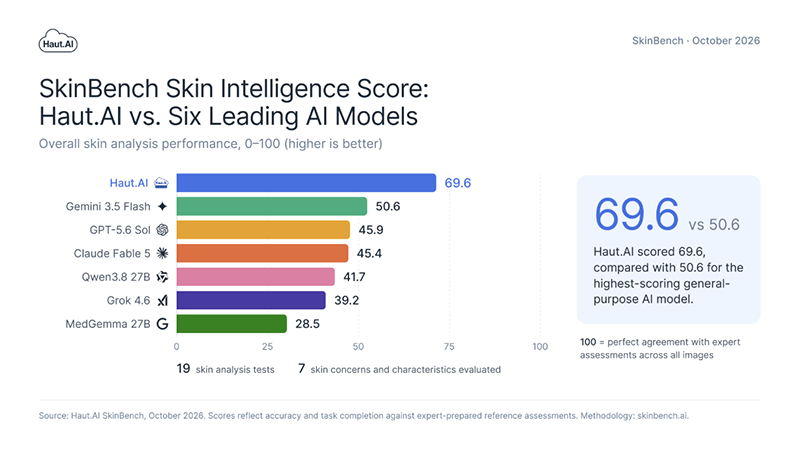
Released by Haut.AI on October 27, 2026, alongside its Skin Foundation Model, SkinFM, it put six leading AI models through 19 tests and found they frequently reported skin concerns that were not there.
When six leading AI models were run through SkinBench, an AI skin analysis benchmark released by Haut.AI on October 27, 2026, they reported eye puffiness in approximately 95% to 100% of images where it was absent. For beauty brands offering AI skin analysis, the result exposes a gap: a model that can describe a photo is not necessarily one that can measure skin.
The gap matters because consumers are already asking AI systems to read their skin. NielsenIQ found that 49% of consumers have taken beauty product recommendations from generative AI, and Accenture found that 75% of beauty consumers are open to an AI-powered shopping experience. A Haut.AI survey of 1,238 U.S. women found that 62% are interested in or already use AI for skincare or bodycare advice.
Businesses are moving in the same direction. In April 2025, Gartner predicted that by 2027 organizations would use smaller, specialized AI models at least three times as often as general-purpose large language models. An AI skin analysis benchmark answers the question underneath both trends: what evidence shows that a model, general or specialized, can actually measure skin?
Why does one accuracy score not tell you whether AI skin analysis works?
A single accuracy score cannot show whether an AI skin analysis system is reliable, because skin analysis is several distinct tasks rather than one. A system has to decide whether a concern is present, grade how severe it is, locate where it sits on the face, classify the skin type, and do all of this consistently across complexions. A strong average can hide a failure on exactly the task a product line depends on.
Each task fails in its own way. An eye cream recommendation depends on whether puffiness is really there. An anti-aging claim depends on knowing where each wrinkle is, so that change can be measured over time. A moisturizer recommendation depends on classifying dry, oily or combination skin correctly. A vendor that reports one blended figure gives a buyer no way to see which of these the system does well.
What does false detection cost a beauty brand?
A false detection, where an AI skin analysis system reports a concern that is not present, becomes a wrong product recommendation the moment it reaches a consumer. Recommendation engines map detected concerns to products, so every concern reported in error adds a product the consumer does not need.
The cost compounds. A consumer can check the result against a mirror, and a recommendation for a concern they can see they do not have undermines trust in the whole service. Progress tracking breaks as well: a concern that was never there cannot show improvement, so before-and-after measurement loses its meaning.
What should an AI skin analysis benchmark test?
An AI skin analysis benchmark, like any vendor evaluation, should report results on each task separately, scored against expert reference assessments in ways that expose failure rather than average it away. Six criteria cover the tasks that matter commercially:
- False detection rate. How often does the system report a concern on images where experts found none? A high detection rate means little if the system reports the concern on almost every image.
- Localization, not just detection. Can the system mark where a wrinkle or spot sits, and how closely does its marking follow an expert tracing? Measuring change and assessing product results both depend on location.
- Skin type classification. Ask for balanced accuracy, a score that counts dry, oily and combination skin equally. Without it, a model can look accurate just by guessing the most common type: if most test images show oily skin, a model that always answers "oily" scores well while being wrong for everyone else.
- Weakest skin tone group. An average across skin tones can hide a group where the system fails. Ask for the score on the worst performing group, not the mean.
- How close the system gets to experts. Even trained experts do not always give the same skin the same grade. How closely experts agree with each other is the most any system can realistically reach, so ask for both numbers side by side: the system's agreement with experts, and the experts' agreement with each other.
- Consistency on repeat analysis. The same skin analyzed twice under the same conditions should return the same result. Ask whether repeatability has been measured, and how. As a reference point, Haut.AI's skin measurement technology was evaluated in a study conducted at Institut d'Expertise Clinique (I.E.C.) in France, compared against a consensus panel of expert graders, and showed repeatability of ICC 0.97 to 0.98 across five facial skin endpoints (an intraclass correlation coefficient, where 1.0 means identical results every time).
Each criterion is only as credible as the methodology behind it. Test images, reference assessments, scoring rules and the list of models compared should be published where a buyer can inspect them. For an example of how repeat skin measurement is applied in large skin studies, see Haut.AI's Clinical Studies Software.
What did the SkinBench benchmark find about general-purpose AI?
General-purpose AI models can describe visible features in a photo, but SkinBench, a public benchmark released by Haut.AI on October 27, 2026, found that six leading models frequently reported skin concerns that were not present and struggled to locate the features they did find. Developed by Haut.AI's Data Science team, SkinBench runs 19 tests across seven skin concerns and characteristics: wrinkles, sun spots, redness, skin tone, skin type, dark circles and eye puffiness. Eleven tests identify and grade visible features, eight measure how accurately models locate them, and all results are compared against reference assessments prepared by experts.
The models in SkinBench are Gemini 3.5 Flash from Google, GPT-5.6 Sol from OpenAI, Claude Fable 5 from Anthropic, Grok 4.6 from xAI and Qwen3.8 27B from Alibaba, plus MedGemma 27B, Google's medically specialized multimodal model. On images where eye puffiness was not present, the six models reported it in approximately 95% to 100% of cases. When asked to trace frown lines, one model marked the nose and mouth instead, and another drew no lines on a test image. Haut.AI’s results on SkinBench come from models powered by SkinFM, the company’s Skin Foundation Model. For each test, the leaderboard reports the best-performing of these models.
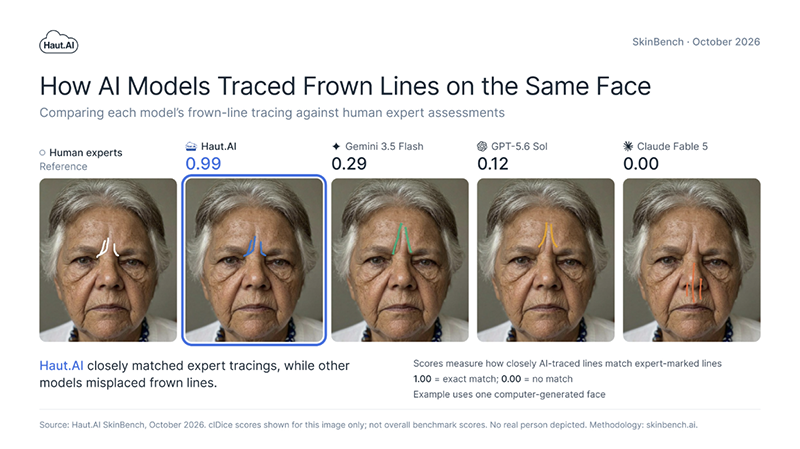
The same computer-generated face five times, showing frown lines traced by human experts, Haut.AI (0.99 match), Gemini 3.5 Flash (0.29), GPT-5.6 Sol (0.12) and Claude Fable 5 (0.00, lines on the nose and mouth).
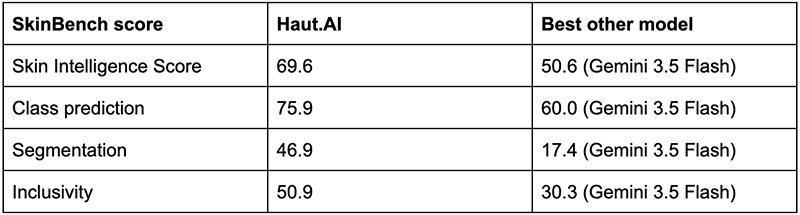
SkinBench reports results at three levels: four headline scores, a score for each of the seven skin parameters, and detailed results for each of the 19 tasks. Each headline score runs from 0 to 100, where 100 means perfect agreement with expert assessments on every image. The Skin Intelligence Score is the overall result, the average of a model's scores across the seven skin parameters. Class prediction measures how well a model grades what it sees, such as the severity of a wrinkle or the type of skin, averaged across 11 grading tasks. Segmentation measures how accurately a model marks where a feature sits on the face, such as tracing a wrinkle or outlining a dark circle, averaged across 8 tracing tasks. Inclusivity is a model's score on the skin tone group it handles worst, so a weak result for one group cannot hide behind a good average.
Haut.AI against the best other model on each headline score:
Individual tests show where the differences come from. When tracing frown lines on 350 computer-generated faces, Haut.AI scored 47.8 out of 100, against 20.2 for GPT-5.6 Sol, the strongest other model. Haut.AI detected deep forehead lines in 82% of the images that contained them, against 15% to 60% for the other models. On frown line severity, Haut.AI's agreement with the expert consensus was 0.82 on a scale of 0 to 1, against 0.73 for GPT-5.6 Sol.
The commercial consequence is the one a false detection creates. "A false detection isn't just a technical mistake. It can lead to inappropriate product recommendations, unnecessary purchases and a loss of consumer trust," said Anastasia Georgievskaya, CEO of Haut.AI.
Where does specialized skin AI still fall short?
Specialized skin AI does not win every task: Haut.AI scored lower than another model on 2 of the 19 SkinBench tasks. Gemini 3.5 Flash scored higher than Haut.AI on grading crow's feet, the fine lines at the outer corners of the eyes (71.7 versus 61.8), and on assessing skin tone (90.4 versus 87.6). Those two results are the clearest argument in the benchmark for judging each task separately rather than relying on one overall score.
Human experts also remain the reference point. On frown line severity, Haut.AI's agreement with expert assessment was 0.82, against 0.86 for the individual human graders measured against the same expert consensus. That SkinBench test used 350 computer-generated faces, so it shows specialized AI approaching human consistency on one narrowly defined task, not matching experts across skin analysis as a whole.
Because SkinBench was developed and run by Haut.AI, its leaderboard, model comparisons and testing methodology are published at skinbench.ai, where anyone can check them. Haut.AI plans to expand SkinBench with additional AI models and with tests of whether models return consistent results when analyzing the same skin concerns, which addresses the sixth criterion above.
What does SkinFM, a skin foundation model, change for brands?
A skin foundation model is a single image-based AI model that analyzes many skin characteristics, in place of a separate model built for each skin analysis task. Haut.AI launched its Skin Foundation Model, SkinFM, alongside SkinBench on October 27, 2026. SkinFM powers the Haut.AI results on the SkinBench leaderboard and is trained on more than 4 million real skin images.
The practical difference is speed and customization. A single foundation lets Haut.AI develop new skin measurements faster and build grading systems tailored to an individual brand's needs. Haut.AI's facial skin analysis can assess more than 230 measured parameters and 48 biomarkers, including wrinkles, redness, pigmentation and other visible skin characteristics.
For brands, SkinFM means skin assessments tailored to their own products and customers, new measurements introduced faster, more informed personalized recommendations, tracking of visible improvement over time, and support for research and product development. It also means more measurements to check. Every new or customized measurement a vendor adds should face the same six tests as the original set, with task level results a buyer can see.


