
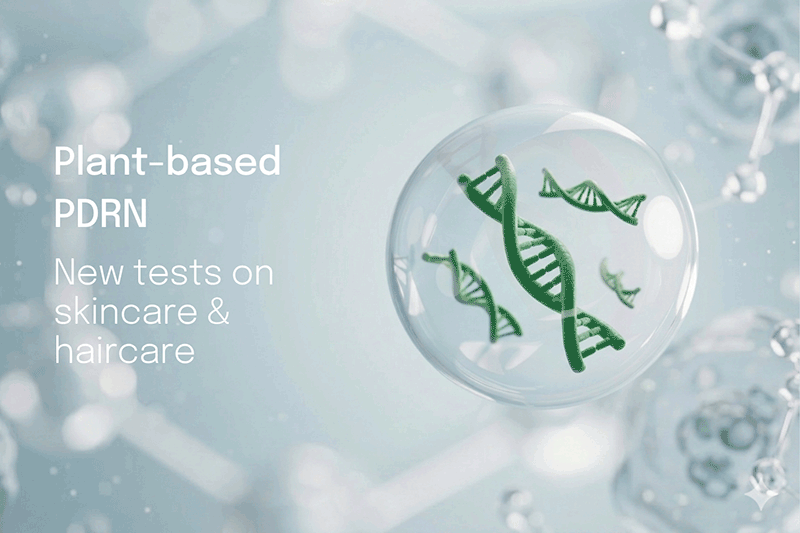
Vytrus’ approach relies on PDRN naturally present in its plant stem cell actives, in two complementary forms: Phyto-PDRN, DNA fragments that act at the cell surface, and ExoPDRN™, PDRN naturally encapsulated within real plant exosomes. Together, they form a dual-action strategy that works both at the cell surface and inside the cell.
For the first time, Vytrus has quantified Phyto-PDRN and ExoPDRN™ in its hair care actives. Capilia Longa™ - Make your hair sprout again, obtained from Curcuma longa stem cells, is clinically proven to reduce hair loss and increase hair density. Scientific literature associates PDRN with hair growth, which is consistent with these benefits. In Elaya Renova™ – The hair tensegrist, from Mediterranean olive stem cells, ExoPDRN™ has been shown to reduce scalp redness versus placebo, supporting a healthy scalp microenvironment.
Elaya Renova™ also adds a new ex vivo study on curly hair. A single leave-on application improved hydration, reduced combing effort and frizz (even under high humidity) and increased curl definition.
These results build on the plant-based PDRN studies Vytrus presented in April for skin care. Centella Reversa™- The equation of youth combines Phyto-PDRN and ExoPDRN™ in its secretome for skin rejuvenation, regeneration and cellular DNA protection, while Sensia Carota™ - Feel good in your sensitive skin contains Phyto-PDRN to calm and protect sensitive skin, reducing redness.
Vytrus now offers formulators a plant-based PDRN portfolio covering skin, scalp and hair: from regenerating and soothing skin care to hair loss prevention, redensification, curly hair care and scalp comfort.
Discover Vytrus’ plant-based PDRN or contact Vytrus Biotech at customer@vytrus.com for further information.


