

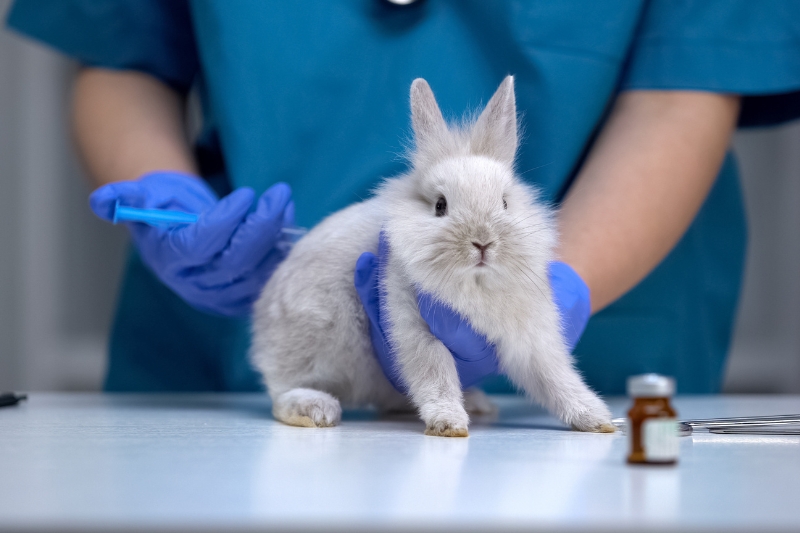
The European Commission has shared a roadmap to phase out animal testing for chemical safety assessments.
The three pillar roadmap lays out the steps to undergo a smooth transition to non-animal approaches while preserving the integrity of safety evaluations.
Building on the existing REACH framework – which provides opportunities to reduce costs and register effectively using fewer animals than predicted – the roadmap reveals 22 actions under the three pillars to gradually phase out animal testing for chemical safety in 15 domains, including industrial and consumer uses and pharmaceuticals.
The first pillar will focus on making change happen towards phasing out animal use.
This pillar will aim to “accelerate the development and uptake of non-animal approaches”, offering over 30 recommendations to replace, reduce or refine animal testing.
The second pillar sets out to keep Europe at “the forefront of research and innovation”, with action points aiming to support a “broad ecosystem of research and business innovation to develop non-animal approaches”, including the use of artificial intelligence (AI) and data sets.
The final pillar is centred around working together in Europe and beyond to put a framework in place to “facilitate implementation with all relevant stakeholders in the EU and to foster collaboration with regulators at international level”.
“The publication of this roadmap marks a pivotal step towards modernising chemical safety assessments while reinforcing Europe’s leadership in innovation,” said Stéphane Séjourné, Executive VP for Prosperity and Industrial Strategy.
“By phasing out animal testing, we are not only upholding higher ethical standards but also strengthening our competitiveness through cutting-edge, non-animal alternative technologies.”
Jessika Roswall, Commissioner for Environment, Water Resilience and a Competitive Circular Economy, added: “Today is a good day for animals and shows that Europe cares.
“After decades of animal testing, we are taking concrete steps to end this.
“Phasing out animal testing for chemical safety assessments based on innovation will be a triple win for animals, the environment and companies.
“We will now build on this collective momentum to implement the roadmap actions.
“This will speed up progress towards a new scientific framework that no longer relies on animal testing.”
Industry responses to the new roadmap for animal testing
Sabrina Engel, chairperson of the European Citizens’ Initiative (ECI) Save Cruelty Free Cosmetics – Commit to a Europe Without Animal Testing, shared a statement on behalf of Cruelty Free Europe, Eurogroup for Animals, European Coalition to End Animal Experiments (ECEAE), Humane World for Animals (formerly called Humane Society International) and People for the Ethical Treatment of Animals (PETA).
Engel said: “We welcome the release of the European Commission’s long‑awaited roadmap to phase out animal testing in chemical safety assessments, signalling an end to nearly half a million invasive procedures inflicted on sensitive and sentient fish, rabbits, rats, and other animals each year.
“The publication of the roadmap is both a scientific milestone and a testament to stakeholder collaboration and ‘people power’, heeding the demands of over 1.2 million citizens for innovative, accurate, humane science.
“The roadmap demonstrates the EU’s commitment to phase out animal testing in safety assessments and recognises that non-animal approaches can enhance the protection of human health, the environment and all animals.
“The focus must now swiftly turn from ambition to delivery.
“With key legislation under the political spotlight, including REACH, it is vital that ECHA, EMA, EFSA, Commission services, and Member States implement the roadmap consistently and transparently, in line with the ECI’s objectives.
“We look forward to being included in the roadmap steering group and stand ready to engage.
“There is no time to waste – for animals, humans, the environment and for the credibility of sound science.
“We must seize every opportunity to move towards a safety assessment system that no longer relies on animals."


