

The study analysed recommendations across ChatGPT, Gemini, Perplexity and Claude, examining which beauty brands appear most frequently, where AI platforms source their answers, and what the results reveal about the future of beauty marketing.
Across more than 1,335 brand mentions and 690 cited sources, the research found that AI visibility is far from random and the brands winning recommendations vary significantly depending on the type of beauty question being asked.
Rather than a handful of brands dominating every conversation, AI models consistently reward brands that have established authority within specific categories.
The top performing beauty brands across all platforms were e.l.f., Maybelline, Charlotte Tilbury, NYX, L'Oréal Paris, NARS, Hourglass, Fenty Beauty, Rare Beauty and Merit.
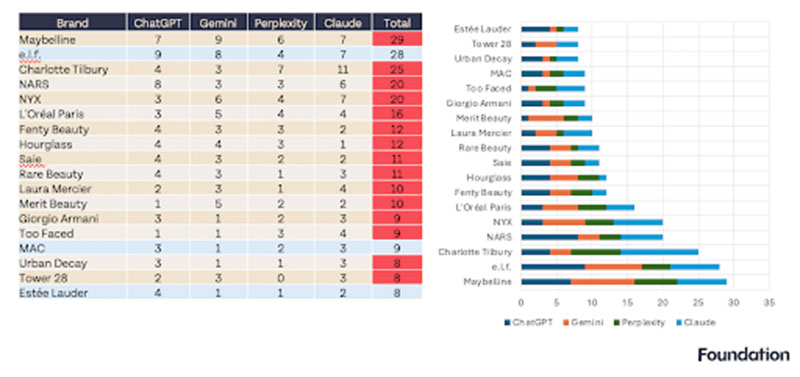
For budget beauty queries, brands such as e.l.f., Maybelline, NYX and L'Oréal Paris were most frequently recommended.
Clean beauty conversations were dominated by ILIA, Kosas, Merit, Saie and Tower 28, while luxury focused prompts favoured Giorgio Armani, Charlotte Tilbury and NARS.
The study also shed light on strong category leaders within specific product areas too.
Charlotte Tilbury, Makeup by Mario, Urban Decay and Natasha Denona emerged as leading recommendations for eye products, while Aquaphor, La Roche-Posay, Laneige and Vaseline were among the most frequently recommended lip care brands.
Olivia Ford, Performance Lead at Foundation, said:
One of the clearest findings from the research is that beauty brands don't need to win every conversation. The brands appearing most consistently in AI recommendations are those that own a particular space, whether that's affordable makeup, clean beauty, luxury cosmetics or a specific hero product category.
The research also uncovered significant differences between AI platforms.
ChatGPT relies heavily on established beauty and lifestyle publications, frequently citing titles such as Vogue, Allure and Cosmopolitan.
Gemini combines editorial sources with official product information and authoritative directories, while Perplexity places greater emphasis on retailer listings and community driven platforms.
Claude showed the greatest diversity in recommendations, frequently surfacing brands that appeared nowhere else in the dataset.
Despite analysing four of the world's leading AI models, the study found remarkably little agreement between them.
Across the entire dataset, only 40 brand recommendations were consistently returned by all four platforms for the same prompt.
The findings challenge another common assumption among marketers: that brand owned content is the primary route to visibility.
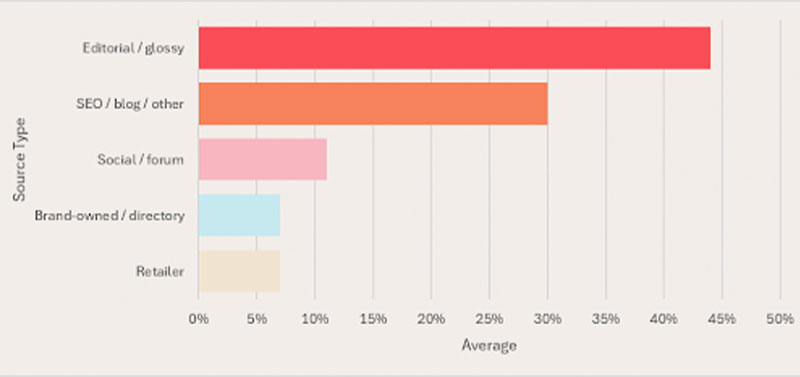
Earned media coverage from editorial Digital PR accounted for 44% of all cited sources analysed, while brand owned content represented just 7%.
Perhaps the most interesting finding was that Reddit emerged as the single most cited source across the entire study, ahead of major beauty publications including Vogue and Allure.
Olivia added:
AI platforms rely heavily on third party validation and although editorial coverage remains incredibly influential, now we’re also seeing that community discussion is just as important.
The brands earning visibility are those being talked about by trusted publishers, retailers and consumers not simply those talking about themselves.
For beauty brands, the findings suggest that focusing on a clear category position, securing coverage in trusted beauty publications and cultivating authentic community engagement are likely to have a greater impact on AI visibility than relying solely on owned channels.
Foundation will be discussing the full findings, methodology and practical implications for beauty brands during its upcoming webinar, Your 2026 AI Beauty Guide.
Register here: https://foundationagency.co.uk/events/your-2026-ai-beauty-guide/
Methodology
The audit was built around 20 prompts designed to reflect how beauty consumers phrase questions to AI tools, rather than how they might phrase a Google search. Examples include "what is the best budget foundation for oily skin" and "how do I get a glowy base without looking greasy."
Each prompt was put to ChatGPT, Gemini, Perplexity and Claude. The full set of 20 prompts was then run a further two times on separate occasions, three runs in total, to establish how consistent the results were over time and across sessions and users. Every brand named in a response was logged, along with its position in the answer and any sources the model cited. This produced a dataset of 1,335 brand mentions and 690 source citations, which was then categorised by brand, category and source type.



