What does Dermaself do?
Dermaself is a Milan-based beauty tech company whose AI analyses skin from a selfie, measuring 60+ visible parameters, and recommends a personalised routine from a brand's own catalogue by reading the INCI list of every product. Brands and retailers use it on their websites, in stores and at events.
The science comes from Derming, an independent research institute in Monza with more than 30 years of dermatological research, which validated the skin taxonomy behind the AI on more than 100,000 clinical images reviewed by board-certified dermatologists.
Why does the same technology work for clinical studies?
Because the hard part of both jobs is the measurement. To recommend the right routine, the AI has to measure skin consistently from any smartphone, in any light. That is exactly what an efficacy study needs to compare a photo taken in week eight with the baseline.
Dermaself's patent-pending colour normalisation corrects light and colour on every image, and on repeated measurements of the same skin the AI shows a repeatability of 0.92–0.93. With that level of consistency, the step from recommending a routine to measuring how skin changes during a study is a short one. So Dermaself built a version of its platform for testing laboratories, which can now run studies with volunteers who take their photos at home.
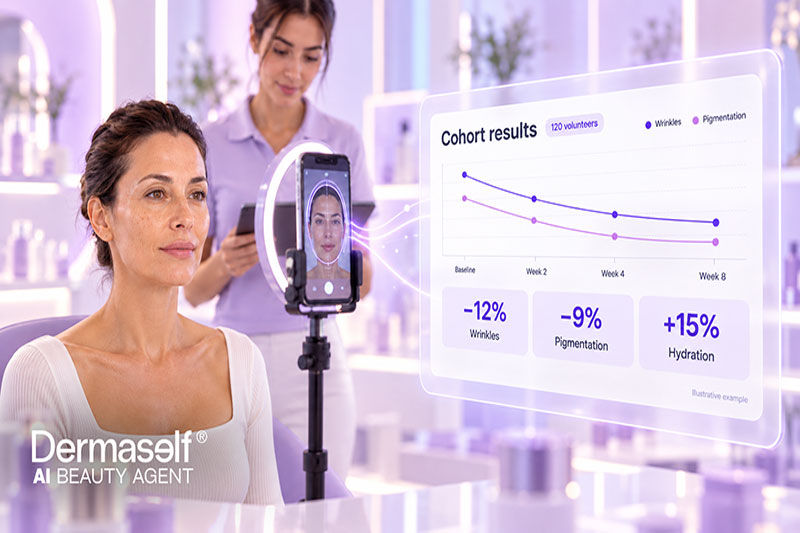
Picture the results deck for your next serum launch. Instead of a few dozen volunteers who came to a test site, it shows thousands of people who used the product in their own bathrooms, on their own schedule, for as long as the study needed. Every photo was scored with exactly the same criteria, and you can see, week by week, which skin parameters improved for each volunteer and for the whole cohort.
How does a remote clinical study work?
The testing laboratory designs and runs the study; the Dermaself platform handles capture, measurement and comparison. In practice, a study follows five steps.
1. Setup. The laboratory defines the protocol, the check-points and the endpoints, choosing from 60+ skin parameters grouped into nine areas. A study can be ready to start in five days.
2. Baseline. Each volunteer takes a standardised photo before using the product, at home or on site, with on-screen guidance.
3. Check-points. Volunteers repeat the capture at each time point in the protocol, for example after two, four and eight weeks.
4. Automatic comparison. The AI measures every image with the same criteria and shows the change for each parameter against that volunteer's baseline, without manual scoring.
5. Report. The laboratory gets results for each volunteer and for the whole cohort, and its experts write the final report and conclusions.
What changes for brands?
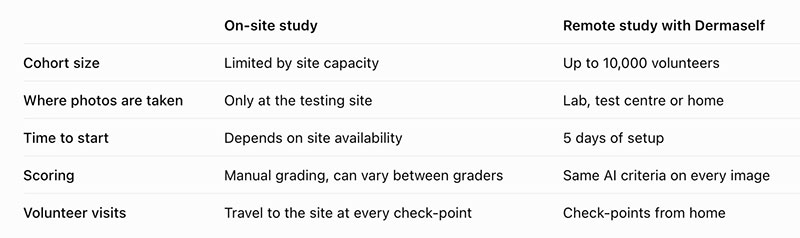
- Remote studies remove the two limits that shape most efficacy testing today: the capacity of the test site and the need for volunteers to travel to it. That opens up studies that used to be too slow, too small or too expensive to run.
- Bigger cohorts. A remote study can include up to 10,000 volunteers, so cohort size is set by the question you want to answer, not by site capacity.
- Real-life use. Volunteers apply the product and take their photos at home, in the conditions in which consumers will actually use it.
- Faster start. Five days of setup, instead of waiting for a slot at the testing site.
- Comparable scoring. Manual grading can vary from one grader to another. The AI applies the same criteria to every image, across volunteers, sites and time points.
- Wider reach. People who cannot travel to a site every few weeks can still take part, which broadens the volunteer poo
The AI does not replace expert graders. It automates the repetitive scoring of study images, while study design, expert evaluation and conclusions stay with the laboratory. Whether the data supports a specific product claim remains a decision for the lab and the brand's regulatory team.
Volunteers' faces are anonymised irreversibly before analysis. Dermaself's patent-pending 3D anonymisation removes biometric identity while keeping the skin data the study needs, and data protection terms are agreed with the testing laboratory before each study starts.
How can a brand get access?
The simplest route is to ask the laboratory that already runs your efficacy studies. Dermaself works with testing laboratories, so a brand does not need to change partner: its lab adds remote capture and AI measurement to the protocols it already designs.
If you are planning a launch, a reformulation or a long-term study, share this article with your testing partner and ask whether the next study can run remotely. Labs can find out more about remote clinical testing with Dermaself and book a demo.
Frequently asked questions
Is the AI used in Dermaself's remote studies the same one brands use for skin analysis online and in store?
Yes. Dermaself uses the same AI skin analysis, built on Derming's dermatological research, both to recommend routines on brand websites and in stores and to measure volunteers' skin in remote studies. In a study, photos are captured under the laboratory's protocol, compared with each volunteer's baseline at fixed check-points and reviewed by the laboratory's experts.
Does a brand need to work with Dermaself directly to run a remote study?
No. Dermaself provides its remote skin measurement platform to the testing laboratories that run efficacy studies for brands, so a brand can keep its current testing partner and ask that laboratory to run the next study with remote capture and AI measurement. The laboratory stays responsible for the protocol, the volunteers and the report.
Can remote AI skin measurement support cosmetic product claims?
Dermaself provides consistent, image-based measurements of skin parameters across a study, but whether the results support a specific claim is decided by the testing laboratory and the brand's regulatory team, who assess the study design, the endpoints and the evidence. In the EU, cosmetic claims must meet the common criteria set by Commission Regulation (EU) No 655/2013.
Can one study mix at-home and in-lab photos?
Dermaself applies one measurement across three capture settings, at home, in a test centre and in the lab, and corrects light and colour on every image, so laboratories can design a study around where their volunteers are. A common example is a baseline taken in the lab, followed by check-points photographed by volunteers at home.
How long can a remote study last?
A remote study on the Dermaself platform can range from a single product test with a few check-points to long-term tracking over several months. Because volunteers photograph their skin at home rather than travelling to a testing site at every visit, long follow-ups are easier to sustain for both volunteers and laboratories.