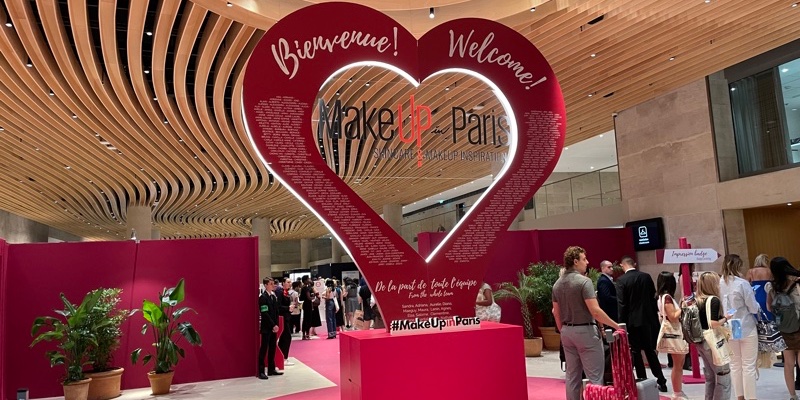
MakeUp in Paris, the original of the international MakeUp in… series of shows, is always a great opportunity to see the latest formulation breakthroughs, packaging unveils and general trends for colour cosmetics.
The B2B event took place 14-15 June this year and, naturally, Cosmetics Business stopped by the Carrousel du Louvre to liaise with exhibitors and discover any stand-out trends and novelties.
Here are some key themes from 2023’s edition.
Eco mascaras
Mascara – which requires multiple components that are engineered to work optimally in conjunction with each other and the formula to achieve desired effects – is a notoriously tricky product to make ‘green’.
But packaging suppliers exhibiting at MakeUp in Paris were clearly making strides in this area.
Italy-headquartered Pibiplast, a long-time MakeUp in Paris exhibitor, showcased a breakthrough called Due, a mascara made out of just two components.
The pack’s name riffs off the Italian for ‘two’.
“It [Due] is a complete action in order to reduce the environmental impact of the production of mascara components,” Stefania Bosi, CCO and Global Sales and Marketing Director at Pibiplast, told Cosmetics Business.
“Normally, mascara is made out of four components plus the brush. Due is made out of two components plus the brush.
“Thanks to three key design solutions, we were able to consolidate two components in one with the cap and rod, and the same in the bottle, integrating the wiper in the bottle neck design.”
Bosi added that reducing the number of processes involved in the mascara’s production reduces both scraps and energy consumption, while integrating the components lowers the pack’s weight.
It is also single material (made entirely of polypropylene, PP) for easy recyclability.
While Germany’s Geka has long offered mascara components – caps, bottles, etc – made from recycled materials, a recent launch pushed at MakeUp in Paris was its recycledFIBER: mascara brushes made of 65% post-consumer recycled (PCR) materials.
“Brands are always looking for the recycled share,” said Stefanie Gunz, Head of Global Marketing at Geka. “This was quite difficult to achieve because you need to tick all of these requirements like food conformity.”
The company now offers two PCR brush options: PCR polybutylene terephthalate (PBT) and PCR polyethylene terephthalate (PET), with Gunz explaining that brushes made from PBT are a little softer with more absorbance to add texture to lashes, while stiffer PET is ideal for eyebrow products.
Green decoration
Also launched by Geka is a patented and entirely-new decoration technique called Shadow Printing.
“It’s a sustainable decoration technology without foil,” explained Gunz. “As we don’t put any colour on top, there is no additional ink, or additional foil. You’re really just adapting the raw material, the plastic.”

Geka's sustainable Shadow Printing decoration technique
Gunz said the process involved is similar to a hot foil printing process, “but we simply remove the foil, so, through the heat of the process, you are able to modify the plastic surface”.
Benefits are said to include reduced materials; 360-degree decoration combining matte and shiny effects; and haptic payoff.
Refill as a design feature
While refillable packs in the skin care space err towards making refill mechanisms as discreetly integrated as possible, make-up is having a bit more fun with its approach.
Britain’s HCP Packaging, for example, showcased its new Grafik refill compact for eyeshadows at MakeUp in Paris.
Available with both round or square profiles, the compact features a bayonet threaded ring which holds the refillable pan in place.
“You can decorate the ring as you want: injected, metalised, or something crazy like metalisation with crackles,” said Claire Marino, Key Account Manager, HCP. “And you can have eyeshadow, but also blush or pressed powder.”
She suggests that beauty brands could sell the rings with different colours and finishes separately to make each pack customisable, citing Guerlain’s bespoke lipstick packs as successful on-market example in action.
“Everything needs to be beautiful, even the technical parts!” she jokes. “We are in the beauty sector; we need to be attractive as well as easy to use.”
Monomaterial everything
HCP’s Grafik pack is monomaterial (PET), something demonstrated more and more by suppliers.
Additionally, HCP showcased monomaterial packs for lip gloss and mascara, featuring PP caps, bottles and rods, with the wiper in polyethylene (PE), which is in “the same family” and therefore the same recycling stream as PP, said Marino.
It is also newly offering 100% aluminium full-sized lipstick packs with different options, “such as a small ring and a flat cap, or fluted design on the base with a larger ring, and the option of removable, collectable charms on the cap”.
On the Aptar stand, meanwhile, the US-headquartered packaging provider launched a full PP, twist-up lip balm pack.
“The challenge is to have something that, when you are twisting, the mechanism is still very comfortable,” explains Patrick Bousquel, Marketing Director, Beauty at Aptar.
“Because, to obtain a slide effect traditionally, you have a soft material and a hard material. But, in this case, you have all of the same material. So you need to have the right experience in working with only the one material.”
Commenting on industry preference, Bousquel tells Cosmetics Business: “Brands and the big groups, sometimes they are really focused on the CO2 impact and then plastic is okay because plastic is the material with the least impact on CO2.
“It uses less temperature compared with glass; less temperature and energy compared with aluminium; and even compared with paper, because for paper you use a lot of water and then you have to dry it, so you use a lot of CO2.
“So some brands feel like this, but then other brands don’t want to see any plastic. So the supplier needs to have more than one solution.”
Bio blenders for make-up
Another traditionally tricky beauty staple when it comes to marrying performance and sustainability is the make-up blender. But MakeUp in Paris 2023 played host to two interesting innovations in this area.
While Act Beauty went down the ultra-sustainable route with a bio-polyurethane sponge that also claims to be 93% degradable in 105 days in household compost, Taiki Cosmetics Europe launched 50% and 70% bio-based versions, designed to be indistinguishable from the blenders that we know and love.
The Taiki blenders use upcycled, non-food plant waste and offer the softness and bounce of a standard petrochemical sponge with controlled cellularity to ensure a nice visual aspect.
The 70% version, known as the Blooming Bio Blender, is achieved with the addition of a vegetal powder and is available in soft or hard density.
However, those brands requiring a supersoft blender, can opt for the 50% version, the Pure Bio-Blender, which comes in all densities.

Taiki Cosmetics Europe offers blenders with 50% and 70% bio-based content
Alix Bellanné, Marketing and Communications Director, Taiki Cosmetics Europe, noted: “We wanted to have exactly the same sponge but bio-based. We didn’t want something with lower quality.
“There are biodegradable sponges in the market, where, after three uses, they have to go in the garbage. They don’t have nice cellularity, there are big holes everywhere and the application is not smooth or even.
“If we didn’t say [this blender] was bio-based you wouldn’t see the difference.”
For very controlled application, the company is also offering a version of its new Duo Blender, where the main body of the blender is bio-based, but the flat part features its Rubycell: a layer of premium polyurethane.
“It means you can use it to finish your eye contour with fixing powder, for example, or if you want high concealer coverage,” said Bellanné, hinting that a greener version of the Duo Blender is in the works: “Rubycell is petrochemical… for the moment!”
Art in a pan
Although MakeUp in Paris features packaging and ingredients suppliers, the majority of exhibitors are third-party make-up manufacturers.
2023’s event saw colour cosmetics makers push out the boat in terms of techniques developed to visually impress clients and end consumers.
Aircos, part of the French Anjac Health & Beauty group, launched Hypnotic Very Noir, a compact eyeshadow with a creamy, powdery texture which produces an intense, golden-black metallic effect.
The original Very Noir is part of Aircos’ Livelogy back injection technology; it is made using two textures and “has a beautiful payoff and a velvet texture”, said Charlotte Lopes D’Azevedo, Sales Manager at Anjac.
She added that the company wanted to build a collection around Very Noir for 2023’s edition of MakeUp in Paris, so it came out with a four-piece eyeshadow palette featuring Very Noir; two versions with finer and larger glitter; and Hypnotic Very Noir as the fourth.
“It is two colours, the new one: black and gold,” added Lopes D’Azevedo. “The two eyeshadows are injected in the same way, at the same time to make a beautiful constellation.”

Maya technology from Chromavis Fareva
The show’s busiest booth – one of four stands in the entrance area tucked discreetly behind black curtains – belonged to Italy-based subcontractor Chromavis Fareva, part of the French Fareva group.
Attendees were queuing up outside, presumably to discover the innovation that scooped the MakeUp in Paris IT Awards’ Coup De Coeur Du Jury: Chromavis’ Maya technology.
With Maya, the company, which aims to be the most “responsible yet disruptive” player in the make-up space, offers multi-layers, with high relief down to 1cm.
“It [Maya] is our new technology platform that allows us to have poured formulas with multi-colours and multi-levels in the same pan,” explained Andrea Brambilla, VP Innovation & Corporate Marketing at Chromavis. “The [highest relief] colour in the centre goes all the way down.
“It’s possible to have different finishes in the same pan, or different levels of coverage using the same formulation,” Brambilla added. “And it is possible to make shapes” – Chromavis’ sample pans, for example, featured heart icons in a ‘Beauty Balm’ complexion formula.
Pencil evolution
Make-up pencils, meanwhile, demonstrated better-than-ever texture, longevity and eco-credentials.
Exhibitor Faber-Castell Cosmetics unveiled its key colour cosmetic trend looking ahead to 2025: the 90’s grunge and punk scene, which it dubs the ‘soft grunge’ trend.
“What we will see is, of course, different black eyeliner looks: like bold, or crease outlines, or both in combination,” said Claudia Heinig, Head of Global Marketing, Faber-Castell Cosmetics.
“Another look is what we call ‘smudging against perfection’, where you use soft and creamy textures, smudging together to blend them for that grungy, imperfect look.”
Tapping into this look, Faber-Castell Cosmetics showcased its Double Ended Liquid Eyeliner with two different tips in one pen. While the client can choose from a variety of different tips, the demonstration example featured a slanted tip for bold lines and a brush tip for fine ones.
For the smudged effect, meanwhile, Faber-Castell Cosmetics released a new ultra-soft texture for its sharpernable plastic lip and eyeliners.
“We have a new texture for eyes and lips, which is super, super soft, gliding and creamy,” said Heinig.
“With the eyeliner you have the perfect setting time. So, if you apply it, you have a short time slot where you can perfectly blend it, but once it’s set, it lasts for 20 hours. The lip liner lasts for eight hours, which is pretty long for a lip liner.”
Longevity was also a box ticked by the latest launch from Schwan Cosmetics, the 2.0 version of last year’s The Better Barrel launch.
The Better Barrel is a barrel that’s not made from plastic, but rather is 72% bio-based and created in collaboration with eco materials maker Sulapac, cutting down on virgin plastic use.
For 2023, “we have a new concept that’s more luxurious with a high-performance formula”, said Jennifer Bieswanger, Director, Global Product Communication.

Schwan's enhanced versions of The Better Barrel concept for 2023
“It’s designed to show that sustainability doesn’t have to be boring, it can be luxury. We have aluminium caps and end caps, and the applicators are all vegan with synthetic fibres.
“The formulation inside is a 3-in1 product which can be used as an eyeliner, a waterliner and you can even blend it to become an eyeshadow look.
“Once the formula sets, it’s really long lasting. It also has an intense colour payoff, a ‘clean’ formula and it’s possible to have flat shades but also highly glittering ones.”
A second elevated version of The Better Barrel, also new for MakeUp in Paris, includes two formulas, one for eyes one for lips, which have a very high natural origin content of about 90%, depending on the shade and pigments used.
“This one we tried to design as sustainable as it could possibly be,” said Bieswanger.
“We tried to use low impact decoration; the caps are monomaterial and recyclable; and the end cap is made from PCR plastics.”