
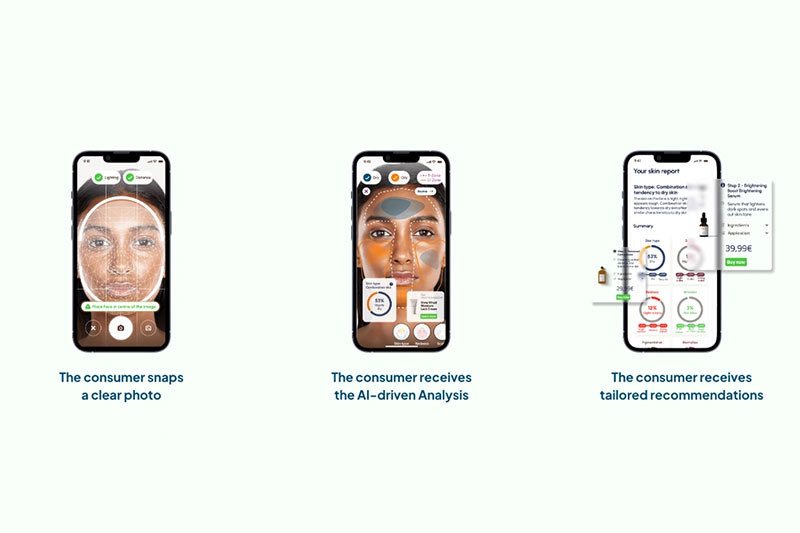
Thea Care (www.theacare.de), a Berlin-based AI company building dermatologist-developed skin analysis technology, focuses on the wider skincare and beauty industry. The technology lets online shoppers take a selfie directly on a brand's website and receive a personalised product or routine recommendation in seconds, closing a guidance gap that costs e-commerce brands sales every day. Thea Care is already in rollout with roughly 25 brands across skincare, dermocosmetics, and beauty e-commerce.
Shoppers don't know which product is right for them: a conversion gap
Skincare brands with broad, concern-led product ranges face a particular challenge online: the products that work best for a given shopper are often not the ones they'd have picked on their own. In a physical store, a beauty advisor closes that gap in a two-minute conversation. On an e-commerce site, that advisor is missing, shoppers guess at what applies to their skin, and the result shows up as abandoned carts, low first-purchase conversion, and product returns once the wrong item arrives.
A selfie replaces the guesswork
Thea Care's technology lets a shopper take a selfie directly on the brand's website and receive an instant, personalised skin assessment. The underlying AI models are built by Thea Care's engineering team and trained on more than 50,000 dermatologist-annotated images covering a wide range of skin types, conditions, and tones. Dr. med. Suzan Helen Stürmer, Thea Care's co-founder and CMO and a board-certified dermatologist, developed the annotation process and reviewed the resulting models. The technology assesses eight skin parameters, and each assessment maps to a specific product or routine recommendation from the brand's own catalogue, running under the brand's own domain and design. Analysis runs on AWS in Frankfurt (eu-central-1); no personal data leaves the EU/EEA for core processing, and a data-processing agreement (AVV) is available for every brand.
A photo, not a quiz
Unlike quiz-based skin finders that rely on a shopper's own guesses, Thea Care's assessment is based on an actual photo analysis: the AI reads the shopper's skin from their selfie rather than asking them to self-report skin type through a multiple-choice questionnaire. That distinction matters for accuracy, and for trust, shoppers can see the same image the recommendation is based on, rather than taking a generic quiz result on faith.
Live in days, not months
For brands evaluating the technology, implementation is deliberately lightweight and fully white-label. Thea Care's AI skin analysis launches as a standalone flow styled to match the brand's own look and language, so shoppers experience it as part of the brand's site rather than a third-party tool. It links from product pages, category pages, or site navigation, and full integration typically takes between two days and a month, no platform migration or lengthy development cycle.
Thea Care measures the impact of every skin consultation at the order level, tracking both direct purchases made immediately after a consultation and downstream purchases attributed to it, giving brands a concrete revenue figure to evaluate the tool against, rather than an engagement metric like completion rate or time on page.
Results: conversion lifts of +90% to +258%
Brands already in rollout with Thea Care see shoppers who complete the AI skin consultation convert at meaningfully higher rates than the shop's average visitor. Across brands, that lift ranges from +90% to +258%, with the spread driven mainly by catalogue depth, how much traffic reaches the analyzer, and whether it's activated through the email funnel.
At Physiogel, a pharmacy-positioned dermocosmetics brand, shoppers who completed Thea's AI skin consultation converted 3.6x as often as the shop's average visitor, a 258% lift over Physiogel's own baseline, per the published case study.
At Judith Williams Cosmetics, a German premium beauty brand, the same consultation flow more than doubled average order value, up 107% per the published case study.
Skincare shoppers don't abandon a purchase because they aren't interested, they abandon it because they aren't sure which product is right for them. Giving shoppers a dermatologist-developed answer to that question, in seconds, on their own phone, is exactly the gap we built Thea Care to close.
— Dr. med. Suzan Helen Stürmer, board-certified dermatologist, Co-Founder & CMO, Thea Care