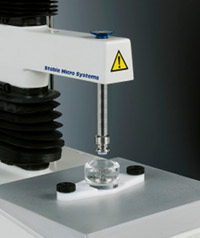
Stable Micro Systems, a UK specialist in texture analysis and materials testing, has unveiled a tablet disintegration rig, which assesses the mechanical properties of fast-melting tablets (FMTs). Attached to the company’s TA.XTplus texture analyser, the rig closely replicates the in vivo conditions of the human mouth, enabling manufacturers to examine water absorption and the disintegration of associated particles into individual components. This allows the determination of tablet disintegration time and behaviour, giving a useful insight into performance and efficacy.
The geometry of the rig allows the disintegration medium to access the tablet from all areas. The dry tablet sample is secured to a probe by a thin strip of double-sided adhesive tape along its diameter. The probe’s surface has a ‘channelled’ design, allowing fluid to flow freely all round the tablet while ensuring contact is maintained with the probe. Once the probe is lowered into the medium, the tablet is positioned on a perforated platform, and the texture analyser applies a constant force onto it. The perforated surface enables free ingress of water beneath the sample and dispersion of the disintegrant.
Jo Smewing, applications manager, Stable Micro Systems, said: ‘The tablet disintegration rig is a more efficient alternative to the older means of assessing dissolution properties traditionally employed by researchers. They involved submerging a tablet attached with tape to the bottom of a cylinder probe and testing the time required for the tablet to dissolve. But the tablet was ‘trapped’ between the tape and the vessel base, restricting its exposure to the medium. The new rig overcomes the issue by allowing the FMT particles to detach easily during the disintegration process, imitating the realistic conditions of drug administration.’
The rig is supplied with five probe heads to enable multiple sample preparation in advance of testing and fast interchange.