
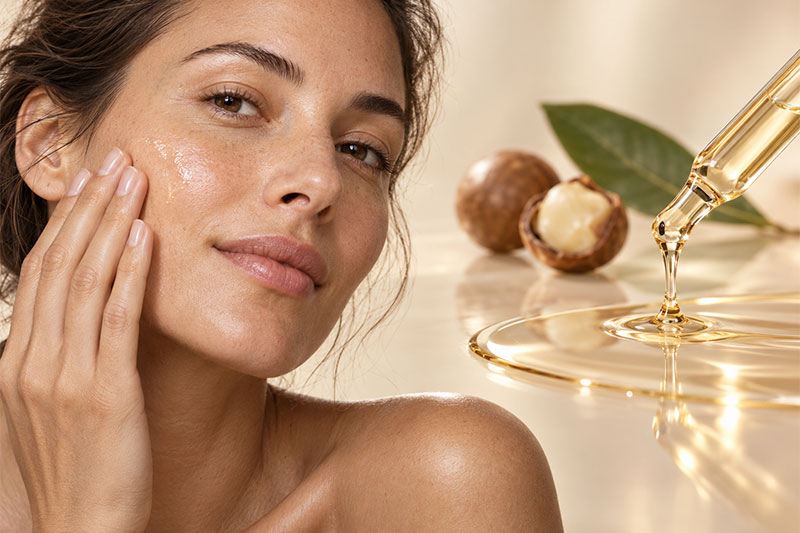
Uniproma is highlighting the potential of Ethyl Macadamiate as a plant-derived emollient for silicone-free and reduced-silicone beauty formulations.
As brands move towards silicone-free positioning, formulators must recreate the smooth glide, rapid spread and refined finish traditionally associated with low-viscosity silicone oils. Without a suitable emollient system, formulations may feel heavy, greasy or slow to absorb.
Ethyl Macadamiate has been developed to help address this sensory challenge through measurable physical performance.
From macadamia oil to a lightweight ester
Produced through biocatalytic transesterification, Ethyl Macadamiate transforms macadamia triglycerides into a lighter, lower-viscosity ester.
The ingredient has a surface tension of 21.9 mN/m, placing it within the 19–22 mN/m range associated with low-viscosity silicone oils. This is also below the 29.1 mN/m measured for crude macadamia oil.
According to Uniproma, the lower surface tension supports rapid spreading and smooth glide, enabling silicone-like sensory characteristics while maintaining a plant-derived positioning.
Comparative testing demonstrates lighter performance
In a comparative evaluation using crude macadamia oil from the same batch, Ethyl Macadamiate demonstrated:
- 3.58 times lower viscosity, measuring 35.6 cps compared with 127.5 cps
- A 40% lower contact angle, supporting faster and more even spreading
- 67.1% less blotting-paper residue, indicating a cleaner and less oily finish
Together, these properties can help formulators achieve rapid glide, reduced drag and a lightweight after-feel without relying on traditional silicone oils.
The results also provide a measurable basis for sensory design, allowing developers to evaluate Ethyl Macadamiate through defined physical parameters rather than positioning claims alone.
Supporting flexible formulation development
Spreadability improvements were observed from an addition level of 2% in meadowfoam and olive oil bases, with performance increasing progressively at higher dosage levels.
Compatibility screening conducted under the specified test conditions also showed compatibility with 21 commonly used oils and emollients. This supports integration into a variety of oil phases without requiring formulators to completely redesign an existing formulation system.
Potential applications include:
- Lightweight facial creams and lotions
- Sunscreens requiring smooth and even application
- Silicone-free hair oils and serums
- Facial oils and other anhydrous systems
- Reduced-silicone formulations requiring a lighter sensory profile
By combining plant-derived positioning with low viscosity, rapid spreading and reduced residue, Ethyl Macadamiate offers formulators an additional route to building silky, lightweight and refined beauty products.
Uniproma said the next generation of silicone-free formulation will be defined not only by the ingredients removed, but by how effectively sensory performance is reconstructed through thoughtful oil-phase design.
Comparative test data, formulation guidance and samples are available from Uniproma for formulators evaluating Ethyl Macadamiate in silicone-free and reduced-silicone systems.