
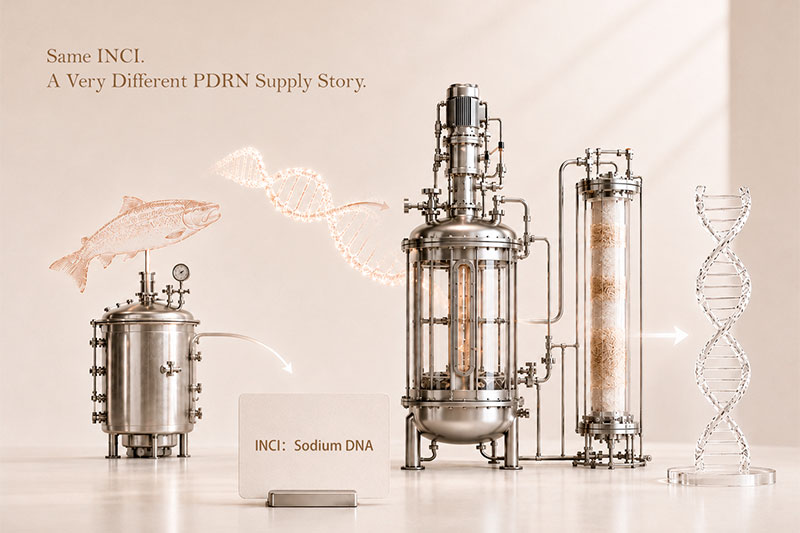
PDRN has become an increasingly visible ingredient in regenerative and premium skincare. However, materials listed under the same INCI name can have very different sourcing and manufacturing stories.
Both salmon-derived and recombinant PDRN can be identified as Sodium DNA, yet their production routes differ considerably.
Salmon-derived PDRN has an established application history extending from wound healing and regenerative medicine into aesthetic and skincare applications. Uniproma used this existing scientific foundation as the reference for its recombinant development rather than beginning with an unrelated biological source.
Following extensive sequencing and comparison with commercial PDRN and PN products, 99 optimal gene fragments were selected for further development.
The recombinant manufacturing process follows a defined sequence of target selection, plasmid construction, microbial fermentation, target-product capture and downstream purification.
Purification is particularly important in fermentation-derived materials. Process controls are used to remove fermentation metabolites, host-cell proteins and host-cell DNA, followed by additional purification using ion-exchange chromatography.
The production model also brings supply considerations into focus. Fermentation reduces reliance on seasonal biological resources and allows operating parameters to be standardised as production moves from development quantities towards commercial scale.
In vivo testing provides further support for cosmetic applications. After 28 days at 0.1%, recombinant PDRN reduced TEWL by 17.37% and erythema by 12.40%, while improving skin elasticity by 30.11% and reducing wrinkle count by 46.67%. The results indicate potential across barrier repair, soothing, firming and anti-wrinkle applications.
As the PDRN category develops, sourcing, purification, manufacturing consistency and scalability are likely to become increasingly important criteria alongside efficacy when formulators evaluate ingredient options.