
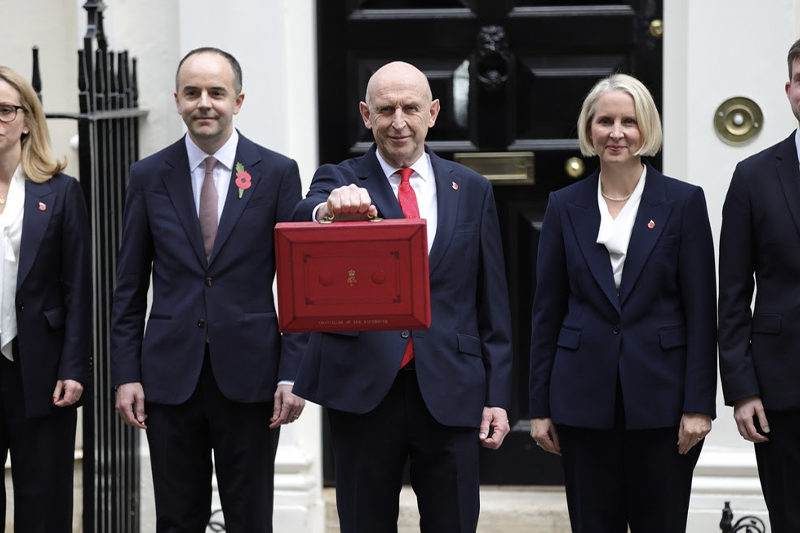
The UK Government’s 2026 Budget has prompted a mixed response from the print and packaging industry, with businesses welcoming selective support for manufacturers while questioning whether the measures will provide meaningful relief across the supply chain.
Among the key announcements, Plastic Packaging Tax (PPT) will increase from £228.82 to £236.56 per tonne on 1 April 2027. The Government also confirmed that pre-consumer waste will no longer count towards recycled content for PPT purposes, while mass balance accounting will be introduced from the same date.
Mandatory certification for mechanically recycled plastic will follow in April 2030. Elsewhere, eligible manufacturers will be able to access savings of up to 25% on electricity costs through the British Industrial Competitiveness Scheme from April 2027.
The main-rate first-year allowance for qualifying investment will increase from 40% to 50% from January 2027, although the writing-down allowance will fall from 14% to 12% in April. The National Living Wage will also rise by 3.9% to £13.21 an hour from April 2027, adding to operating costs.
The Food and Drink Federation (FDF) argued that food and drink manufacturers had been overlooked
The Foodservice Packaging Association (FPA) welcomed support for energy-intensive manufacturers and investment, but warned that businesses face growing costs and complexity from PPT, extended producer responsibility (EPR), packaging recovery notes and the forthcoming Deposit Return Scheme.
It called for a coordinated review of packaging policy, highlighting concerns that compliance costs are disproportionately borne by responsible businesses and that producers need clearer evidence of improvements to recycling infrastructure.
The Food and Drink Federation (FDF) was more critical, arguing that food and drink manufacturers had been overlooked. Chief executive Karen Betts said the sector had not received the energy support available to other manufacturing industries, despite energy costs being twice the European average.
The British Plastics Federation also questioned the limited support available to its members. Industrial and public affairs manager Mohamed Elkhalifa said plastics, the UK's third-largest manufacturing sector by employment, had no dedicated support fund, despite the high energy costs facing the industry.
There was more positive feedback from the Packaging Federation. Chief executive Martin Kersh welcomed the Government's commitment to reducing unnecessary regulation and improving industrial competitiveness, but called for the packaging sector to have a direct voice in the work of the new Better Regulation Executive. He also backed an urgent review of EPR.
Three themes emerged: uncertainty over who will benefit from Government support, the need for investment across people and technology, and calls for packaging taxes and regulations to work together more effectively
For some businesses, the investment measures offer opportunities, although their reach remains uncertain. Jo Stephenson, managing director of Think B2B Marketing, said the Budget offered selective cost relief, but that eligibility would determine which parts of the packaging supply chain benefited from energy support.
Gillian Garside-Wright, director of consulting at Aura Global, added that investment should extend beyond machinery to include digital capability, automation, skills and the infrastructure needed to make circularity commercially viable.
Across the responses, three themes emerged: uncertainty over who will benefit from Government support, the need for investment across people and technology, and calls for packaging taxes and regulations to work together more effectively.
While the Budget may have been described as uneventful, its impact on packaging businesses will depend on how the measures are implemented – and whether they provide sufficient confidence for companies to invest, innovate and remain competitive.


