
A New Era for Fragrance Innovation
Regulatory shifts aimed at lowering VOC (Volatile Organic Compounds, including alcohol) content to reduce emissions are accelerating the move toward new types of formulas across beauty categories. At the same time, consumers are embracing gentler formulations with natural ingredients and added skincare benefits, pushing brands to rethink traditional perfumery.
Three new territories for innovation are emerging in the fragrance market:
Alcohol-free Fragrances: A Growing Interest from Brands
Once primarily targeted at children, alcohol-free perfumes are now gaining traction among a broader audience seeking non-irritating alternatives for sensitive skin or due to cultural preferences. The alcohol-free fragrance market reached an estimated $1.92 billion in 2024, with promising new launches emerging. These formulas require fragrance pumps specifically engineered to dispense higher-viscosity or biphasic liquids while still delivering the fine, elegant mist expected from a perfume.
Microencapsulated Fragrance: A Promising Technology
The microencapsulated fragrance market is projected to grow from $1.5 billion in 2024 to $3.2 billion by 2034, with an 8% CAGR. Encapsulated fragrance molecules suspended in the formula enable controlled release and new sensorial experiences. These formulations require specialized dispensing systems capable of spraying both the gel and the microcapsules simultaneously, without clogging.
Hybrid Perfume–Skincare Formulas: Added Skincare Benefits
Driven by the “skinification” trend, skincare-infused fragrances are blurring the lines between fragrance and skincare. Consumers increasingly expect perfumes to hydrate, soothe, or protect the skin. These enhanced formulas require high-precision dispensing solutions that preserve formula integrity while elevating sensorial performance.
Navigating the Technical Packaging Challenges of New-Generation Fragrance Formulas
New-generation formulas introduce compatibility challenges and technical constraints.
Alcohol-free Formulas: Preserving Sensoriality and Performance
Alcohol acts as a neutral olfactory solvent and enables instant evaporation, leaving a dry feel on the skin. Water-based and alcohol-free formulas must rely on alternative stabilizers and volatile components, such as biphasic or glycerin-enriched systems, to maintain fragrance intensity and stability.
In hybrid formulations, the pump plays a key role in delivering a premium sensorial experience. Variations in viscosity and density make it more difficult to achieve a fine, homogeneous spray that does not feel overly wet or produce visible droplets.
Aptar Beauty’s HDS INUNE and HDS VP4 fragrance pumps are designed to address these challenges. These high-performance pump and insert combinations deliver a wide-angle, homogeneous spray that preserves the premium experience expected from traditional fragrances.
Microencapsulated Fragrances: Managing Controlled Release
The main challenge with suspended fragrance capsules is maintaining their integrity within both the bottle and the pump system. To preserve freshness and performance, the fragrance must be released at the moment of dispensing. The pump must therefore deliver both the gel and capsules simultaneously, in a balanced ratio, without clogging.
Aptar Beauty’s Applied Sciences and R&D teams have developed optimized cartridge and insert solutions to ensure seamless diffusion of hybrid formulas, including those containing suspended capsules.
Anticipating Tomorrow’s Fragrance Formulas, Today
Aptar Beauty recognizes that next-generation fragrance formulas require adapted dispensing technologies. Its Applied Sciences team, based in Le Neubourg, France, has been working independently on this topic for more than three years. The team has implemented a proactive development strategy to support brands exploring innovative formulas, including:
- Advanced in-house testing for pump/formula compatibility
- Strategic collaborations with ingredient and formulation specialists
- Direct co-creation with fragrance houses
“Fragrance formulas are evolving and fragrance pumps need to adapt. We have been preparing for this shift and optimizing pump and formula combinations for maximum efficiency,” said Thomas Clemence, Scientific Material and Formulation Manager at Aptar Beauty.
This forward-thinking approach ensures Aptar Beauty’s dispensing solutions remain aligned with the evolving landscape of fragrance formulations, positioning the company as a technical enabler for brands exploring the future of fragrance.
Case Study: Guerlain Aqua Allegoria Perle
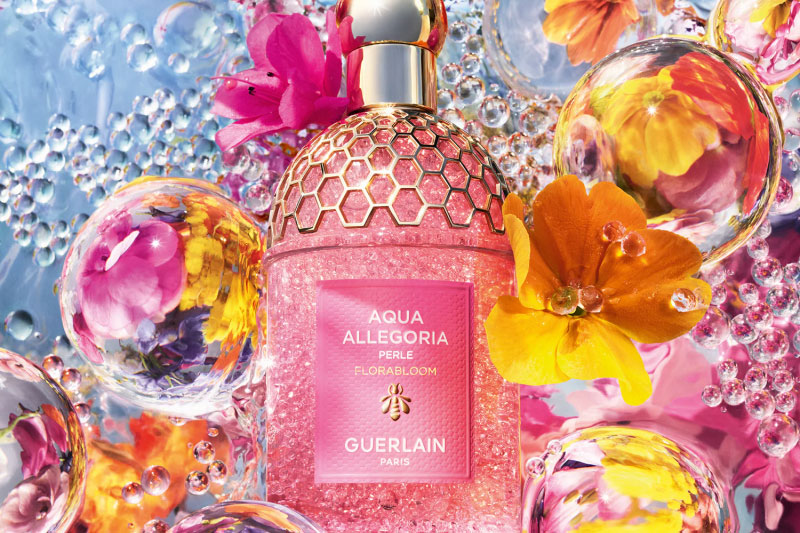
Guerlain’s latest limited-edition fragrance, Aqua Allegoria Perle, illustrates the evolution of fragrance formulas and Aptar Beauty’s role in supporting innovation. It is the brand’s first fragrance featuring micropearl technology.
Aptar Beauty partnered with Microcaps, a Swiss specialist in perfume microencapsulation, to optimize the hybrid formula for effective dispensing. The fragrance is encapsulated in microbeads and suspended in an alcohol-free aqueous base enriched with glycerin. This biphasic formula combines the intensity of an Eau de Parfum with the hydrating benefits of skincare.
“We approached Microcaps ahead of the project to develop the ideal formula and pump combination. This proactive work enabled Guerlain to optimize its formula and reduce time-to-market,” added Thomas Clemence.
Aptar Beauty’s R&D teams worked closely with Guerlain and Microcaps to refine the formulation, determining the optimal ratio between capsule density and gel viscosity. The final solution combines Aptar Beauty’s VP4 premium fragrance pump with its High-Definition Spray (HDS) insert, delivering a fine mist with wide-angle diffusion and smooth, clog-free actuation.