
We are proud to announce that a groundbreaking dsm-firmenich manuscript has been published in the Journal of Investigative Dermatology (JID)—one of the highest-ranked journals in dermatological science. The paper, now in press, introduces a novel approach to visualiSing the skin microbiome in unprecedented detail.
This achievement reflects the strength of our cross-functional collaboration model, bringing together expertise from dsm-firmenich Beauty & Care R&D, Science & Research, Animal Nutrition & Health, and external partner Bio-Me. It exemplifies how combining capabilities across disciplines accelerates innovation and delivers meaningful scientific breakthroughs.
A new paradigm for mapping the skin microbiome
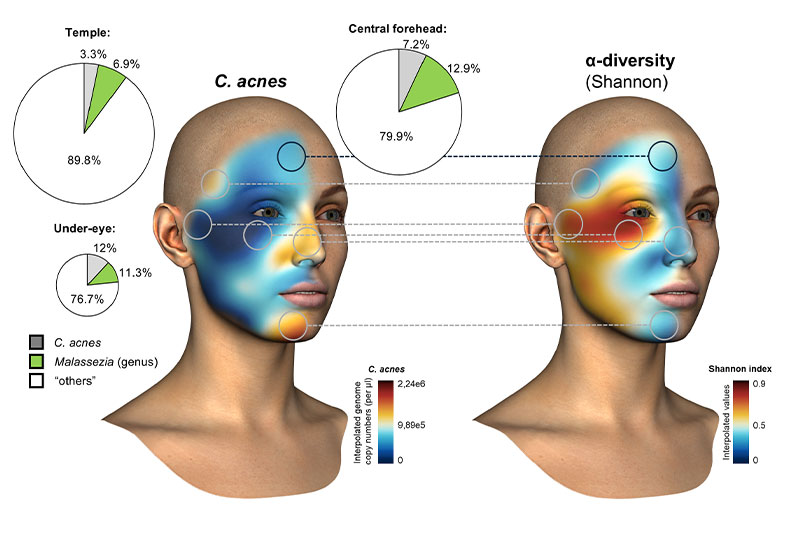
Titled “3D Facial Skin Microbiome Mapping: An Integrated Technology for Continuous Visualisation of Absolute Microbial Densities,” the study addresses long-standing limitations in microbiome research.
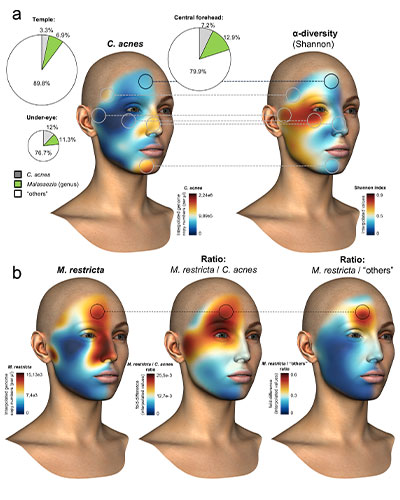
While traditional approaches rely on relative abundance data from a limited number of sampling points, this proof-of-concept introduces absolute quantification of 26 bacterial and fungal species across 24 facial sites, combined with AI models. Using a smooth interpolation method, the team created the first continuous 3D maps of the facial microbiome, offering a holistic and high-resolution view of microbial topography.
Key scientific advances
This work delivers several important breakthroughs:
High-resolution visualisation
Continuous 3D mapping enables an intuitive and comprehensive view of microbial distribution across facial skin.
Deeper biological understanding
The study reveals spatially distinct bacterial–fungal interactions, including potential competitive dynamics between Malassezia restricta and Cutibacterium acnes.
Smarter sampling strategies
Machine learning models demonstrate that a reduced set of sampling sites—down to nine—can accurately capture microbiome variability, with the central forehead emerging as a key predictive location.
Strong translational potential
The technology creates new opportunities to monitor microbiome-modulating treatments, design targeted interventions for dysbiosis, and link microbial data with skin physiology.
Driving the House of Science forward
The acceptance of this publication in JID is a strong validation that dsm-firmenich Beauty & Care’s pioneering microbiome science, is on the right trajectory and reinforces its role as a core pillar of our House of Science. It underlines our commitment to advancing credible, cutting-edge science that bridges fundamental research and real-world beauty industry applications.
Opening the door to new collaborations
We invite partners, customers, and members of the scientific community to build on this work with us. Together, we can further explore the spatial interactions between cosmetic actives and the skin microbiome, advancing microbiome-entered innovation and substantiating differentiated and future-forward claims.



