
A brave new world: Beauty's fascination with outer space

Whether it be product development, marketing materials or PR stunts, outer space has been a constant source of inspiration throughout beauty’s history. And now, the industry is going where no brand has never gone before

You need to be a subscriber to read this article.
Click here to find out more.

The race into space began in 1955 when the two Cold War countries, the US and the Soviet Union, began battling it out for superiority among the stars.

What was seen as reaching the next frontier became an obsession of the mid-20th century, and dominated modern warfare. America was effectively crowned ‘triumphant’ when Neil Armstrong famously declared: “That’s one small step for man, one giant leap for mankind”, with an estimated 650 million people watching in 1969.

But it wasn’t until much later that beauty’s obsession with the cosmos’ majesty began, and one of the first beauty brands to have any connection to space comes in an unlikely form.

Crème de La Mer, the skin care hero of the luxury Estée Lauder-owned company, was established by aerospace physicist Max Huber after suffering burns in a lab accident. Twelve years of investigation and 6,000 experiments later, according to the brand, he managed to create his perfect elixir to transform the look of his skin.

Later, dozens of brands would take inspiration from outer space to master skin care for us mere mortals. In the early 2000s Estée Lauder began using digital image analysis and software based on NASA lunar research to evaluate its cosmetic products.

Meanwhile, L’Oréal’s cosmetics research has also derived from space technology. By using pollution maps and ultraviolet radiation data from the European Space Agency, the centenarian old brand was able to look into the possibility of developing skin care products that are customised to consumers’ climates.


Just a few years later in 2017, Perricone MD’s released its revolutionary Cold Plasma+ range that was developed with the United States’ Los Alamos National Laboratory of New Mexico – a site initially introduced during World War II for the design of nuclear weapons as part of the Manhattan Project.

Dr Perricone’s research involved generating cold plasma using electric fields instead of heat, inspiring him to use ions in a skin care formula that had previously not been compatible with other beauty ingredients.

But the intergalactic universe has not just been a source of research for beauty companies on a mission to advance their formulations. It has also provided a source of inspiration for product creation and marketing materials.

In a galaxy far, far away

The year 2020 was tipped to be the year for extraterrestrial beauty. Searches for space-themed beauty rocketed more than 200% during 2019, according to social media site Pinterest, in its annual forecast for 2020.

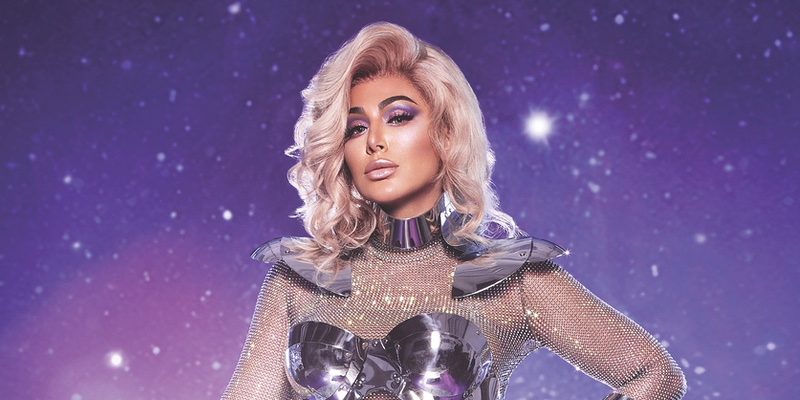
Purple lip glosses, black lipstick and icy blue eyeshadows were in at the time, with the likes of Huda Beauty launching its Mercury Retrograde Palette and Pat McGrath Labs harnessing the power of the force for its Star Wars collab with Disney.


Pantone’s Colour of the Year 2020 ‘Classic Blue’, said to be ‘comforting and relatable’, also gave rise to a new fascination with space.

Likely no creature on Earth or beyond its orbits could have predicted what 2020 would have in store, however. But like so many things, Covid-19 interfered, putting beauty’s Space Race on hold, with intergalactic beauty sidelined for skin and self-care as consumers suffered through months of lockdown with no social occasions to show off space-themed looks.

But now it’s time for a role reversal, and brands are once again turning to the galaxies far far away for inspiration.

One of the newest, and in fact most anticipated launches of 2021, was the make-up launch of pop princess Ariana Grande. Finally, in November Grande lifted the lid on her, you guessed it, space-inspired cosmetic creation.

Building on her fragrance empire with Luxe Brands, the ‘Thank U, Next’ singer dropped her R.E.M. Beauty line with Forma Brands: a selection of colour cosmetics made up of ‘chapters’. Her debut line took the form of an intergalactic-influenced line with a selection of eye shadow palettes, foundations, lip glosses, lipsticks and highlighters.

“Travel through space and time to a world of cosmic illusions and futuristic lust,” wrote the brand at the time of its launch.

Ariana Grande's R.E.M. Beauty was inspired by space

Ariana Grande's R.E.M. Beauty was inspired by space

“From graphic eyes and flutter-worthy lashes to extragalactic highlights and lips that make a statement, this is everything dreams are made of.”

Byredo developed its Travx Space Range with US rapper Travis Scott, with the caption ‘Wonder what space smells like?’. The team used top notes of ‘cosmic dust’, with a heart of, what Byredo called, ‘the scent of supernova’ and base tones of ‘atmospheric capture and dark nebulae’.

Meanwhile, The Perfume Shop blasted off customers’ messages to the edge of Earth’s atmosphere, by high-altitude balloon for an otherworldly Mother’s Day campaign.

Safe to say, beauty's relationship with space is by no means over.

But beauty has gone beyond cosmos-themed eyeshadows and lip colours that are decked out with metallics of purple and silver – as delving beyond the constraints of our planet becomes more than just a billionaire’s pass time.

Sky’s the limit

In 2020, Estée Lauder became the first beauty name to take advantage of NASA’s drive to commercialise low-Earth orbit and sent its Advanced Night Repair serum on a mission to the International Space Station (ISS).

The product was strapped aboard spacecraft Cygnus on an Antares rocket, and once safely docking on the ISS, a selection of photographs were taken for the company to use on social media and in other marketing materials.

Of course, astronauts do not go into space without personal care items of their own, but the luxury skin care name was certainly the first to pull a marketing stunt out of it.

But more than just putting a serum among stars, beauty brands are building on research in outer space that will benefit our life here on Earth.

Sticking with Estée Lauder, the company announced in 2021 that it would fund a research project, in partnership with the ISS US National Laboratory, helping one research team to put their experiment on the Space Station.

While American taxpayers foot the bill for the majority of the expedition, a cost does incur when hardware for research needs to be sent into space, which Estée Lauder is willing to pay for. The experiment chosen for the mission will be based on how to improve alternative plastic solutions here on Earth, and is due to blast off this summer.

Estée Lauder became first beauty brand to send its serum to outer space

Estée Lauder became first beauty brand to send its serum to outer space

Speaking to Cosmetics Business, Patrick O'Neill, Public Affairs and Outreach Lead for the ISS National Laboratory explains that the beauty of sending these experiments into space, is that age old saying, or to quote Forrest Gump, ‘You never know what you’re going to get’.

“When sending research to the space station, you just don't know what you're going to get,” he notes.

“We understand how things often react in a gravity-filled environment, most scientists understand reactions, they understand physics, they understand bio-life sciences, etc. When you send something to a unique place that you are not familiar with, you're going to learn things that literally you've not experienced in the past.”

He adds: “We're starting to see that there's a strong demand from companies, and just general researchers alike, to take something novel to that unique environment and see what happens.”

Also making a splash in space is personal care group Colgate-Palmolive. Last year, the group became the first private sector business to launch an oral care experiment to the ISS. Again in partnership with the National Laboratory, the on-board experiment was designed to learn more about the growth and metabolism of oral biofilms, which take the form of dental plaque that can lead to gum disease.

“Colgate-Palmolive is committed to innovation that supports our purpose to reimagine a healthier future for all,” Lia Arvanitidou, Vice President, Global Personal Care, Skin Health & Home Care R&D, Colgate-Palmolive Company tells Cosmetics Business.


“We rely on science-backed research to discover and develop solutions for consumers around the world. That includes our skin health business, where our scientists have published four papers in peer-reviewed journals since 2020, including three from PCA SKIN.

“Now we’re going beyond our world and into space to test what we know and learn what we don’t.”

“This investigation will be the second time C-P has leveraged the microgravity environment aboard the International Space Station (ISS) National Lab to learn more about personal care products.

Our expectation is to leverage data gained from both our earlier oral care experiment and the coming skin health investigation to further innovate, developing new products to help everyone achieve a healthier future.

And, according to O’Neill, there are so many more opportunities for companies, be it personal care or otherwise, to become involved in space-based research. In March, the first-ever private mission, with astronauts not from NASA, is due to take place.

“This is going to be a unique case study for us for two reasons: one, it will be the first of its kind and two, who's to say that one day down the road, that as this use case gets built out, there might be other companies, whether it be a Colgate Palmolive or an Estée Lauder [...] who sit there and say that they see the value of sending a private astronaut to the space station to do a series of investigations.

“That day might be coming a lot faster than we think it is.”

Essentially, O’Neill’s predictions are that space research will become commercialised, and private sector companies will develop their own resources to carry out experiments in outer space that will benefit our planet.

But while we wait for that to evolve and more beauty companies to jump aboard the proverbial rocket, there are questions that still need to be asked on how the personal care routines of astronauts can be improved while embarking on their missions.

Beauty beyond Earth

Megan McArthur has been a NASA astronaut for more than two decades and has flown on multiple missions; most recently, landing home in November 2021 after a stint on board the SpaceX Crew Dragon spacecraft, named Endeavour.

And while her feet were solid on our soil, Cosmetics Business found out more about her space-specific beauty bag: from velcroing commercial products on the wall, to foil packed hand towels for showers and using just 400 millilitres of water for a “good” hair wash.

“You have some ability to select the items that you want. So your deodorant, your toothpaste, your toothbrush, you get a razor men can choose if they want, but there are also some constraints on what you can have.”

With living in a closed environment, the spacecraft’s air recycling system is crucial to having a clean atmosphere, so that chemicals in the air can be cleaned away, which poses a problem for a number of cosmetics.

Products with alcohol are strictly forbidden as it's hard for the recyclers to clean – so fragrance is out. But also products that contain siloxane can cause ‘lifetime issues’ for the astronauts’ hardware.

“That was a little bit hard I found, I had never thought about that before. But then it became difficult to find commercially available products that didn't have siloxanes in them,” McArthur adds.

But developments in space-specific personal care are getting some attention. Kao Corporation’s 3D Space Shampoo sheet was selected for a mission to the ISS by the Japan Aerospace Exploration Agency (JAXA) that will take place this year.

With water being a precious resource upon a spaceship, not to mention a weightless environment posing challenges for hair washing, Kao’s new non-woven fabric sheets have been developed with an uneven three-dimensional shape that does not need water to wash the hair.

And the issue of water is something else McArthur needs to be aware of in spaceflight, due to the fact that as much water as possible has to be recycled in space. Refuelings do come from Earth, but as missions are destined to become longer, there is a greater need to recycle water, putting face scrubs and washes on the back burner.

“The products that require the least amount of water to be effective, are what’s going to be most beneficial to astronauts,” McArthur explains. The lengths to save water go as far as leaving out weekly hand and face clothes to dry in the atmosphere, to ensure that it is taken in by the recycling system and used again.

“Typically, when I was going to do a really good wash of my hair, I would use around 400 or 500 milliliters of water. So what that would look like is two foil pouch drink bags that we have, and as long as you're not moving really rapidly, the water will tend to stay.”

Whether it be product inspiration, private sector missions or shampoos that are designed to take the headache out of a hair wash, beauty’s relationship with the cosmos is deeper seated than what appears on the surface – and there’s plenty of room for improvement.

Watch this space.

You may also like